
5 Things Your Tesla Is Tracking That Most Owners Never Check
1. What does your Tesla track: your real cost per km
Wondering what does your Tesla track behind the scenes? Your Tesla is one of the most data-rich vehicles ever built — every charge session, every trip, every kWh is logged. But most owners never look beyond the range estimate on the dashboard. After tracking 275 real charge sessions and 5.86 MWh of charging data through Voltayze, here are 5 metrics that tell a far more interesting story.
| Metric | My real data |
| Total charges | 275 sessions |
| Total energy | 5.86 MWh |
| Total cost | 6,178.73 RON (~€1,235) |
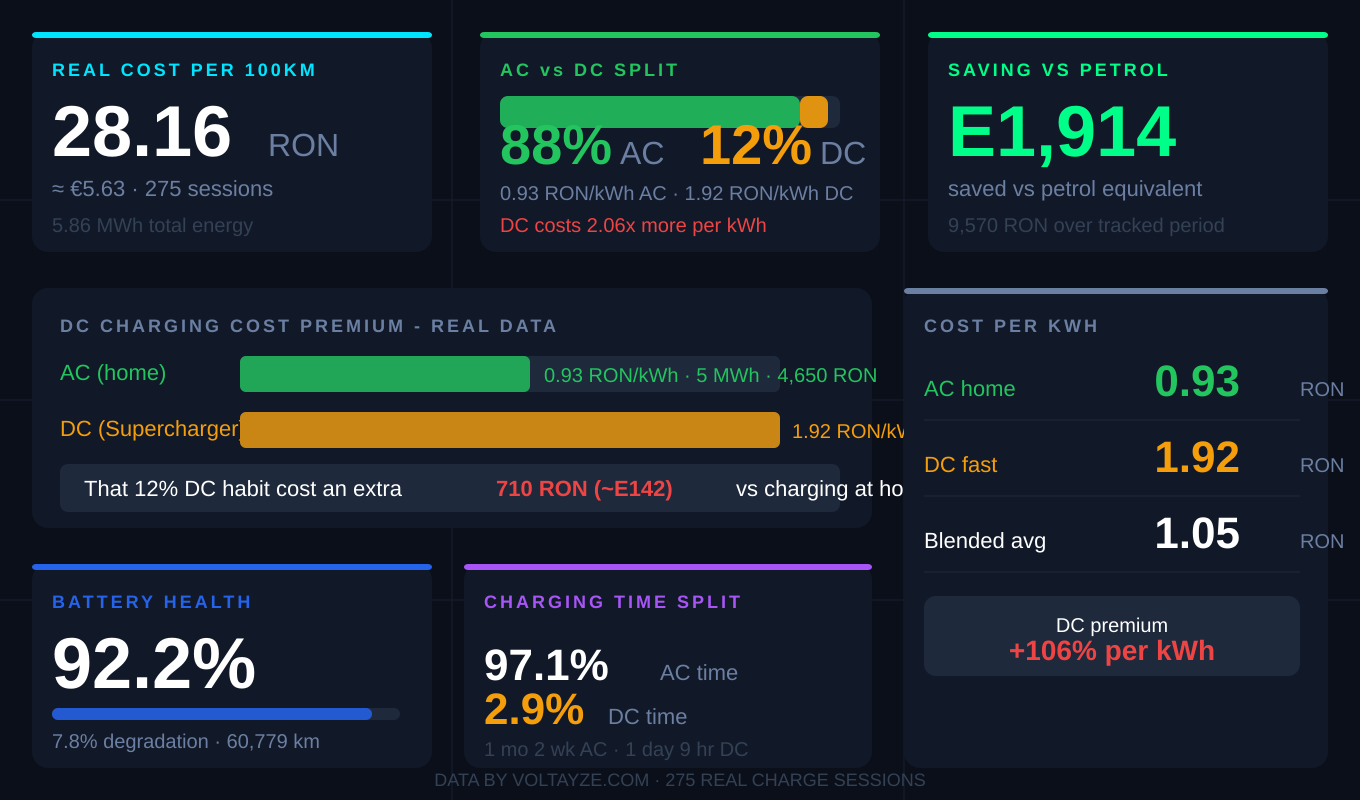
| Real cost per 100 km | 28.16 RON (~€5.63) |
| Average cost per kWh | 1.05 RON (~€0.21) |
2. What does your Tesla track: your DC vs AC split and what it costs
This is the metric that surprises most Tesla owners when they see it for the first time. Every Supercharger session costs significantly more per kWh than home charging — but most owners have no idea what their actual split is or what the difference costs them annually.
My data shows 88% AC (home charging) and 12% DC (Supercharger). The cost difference is stark: AC costs me 0.93 RON/kWh while DC costs 1.92 RON/kWh — more than double.
| Charging type | Energy | % of total | Avg cost per kWh | Total cost |
| AC (home charging) | 5.00 MWh | 88% | 0.93 RON (€0.19) | 4,650 RON (~€930) |
| DC (Supercharger) | 717 kWh | 12% | 1.92 RON (€0.38) | 1,377 RON (~€275) |
| Blended average | 5.86 MWh | 100% | 1.05 RON (€0.21) | 6,178 RON (~€1,235) |
The 12% DC charging cost me 1,377 RON — 29% of my total charging bill, despite being only 12% of my energy. If I had charged that same 717 kWh at home instead of Superchargers, it would have cost 667 RON. That 12% habit cost me an extra 710 RON (~€142) over the period tracked.
The DC charging premium: my Supercharger sessions cost 2.06x more per kWh than home charging. Over a full year, moving from 12% to 5% DC charging would save approximately €80–100 — without driving any differently.
3. How much time your Tesla spends charging vs driving
The AC/DC duration split is even more revealing than the energy split. My data shows AC charging accounted for 97.1% of total charging time (1 month and 2 weeks) while DC was only 2.9% (1 day and 9 hours).
This makes sense — home charging is slow (7–11 kW) but happens overnight when the car is parked anyway. Supercharging is fast (up to 250 kW) but you’re actively waiting. The duration data confirms I’m using the right charging strategy: slow cheap AC for daily needs, fast expensive DC only when genuinely needed on trips.
The insight: if your DC duration is disproportionately high relative to your energy split, you’re likely Supercharging out of convenience rather than necessity — and paying a premium for it.
4. Your battery health — and whether your charging habits are protecting it
Tesla doesn’t show battery health as a percentage in the car’s interface. Without a third-party tracker, most owners have no idea whether their battery is degrading faster or slower than average.
Battery degradation is directly influenced by charging habits — specifically how often you charge to 100%, how frequently you use DC fast charging, and how often you deplete below 10%. These are the same habits that also affect your cost per km, which means good charging discipline protects both your wallet and your battery simultaneously.
Real data benchmark: we previously published data from three tracked cars showing degradation of 3.5% at 66,000 km (mostly AC charging), 7.8% at 60,000 km (12% DC), and 9.6% at 244,000 km (100% AC). The pattern is consistent — DC-heavy charging correlates with faster degradation, especially in younger batteries.
5. What does your Tesla track: your monthly savings vs petrol
This is the metric that makes EV ownership feel real rather than theoretical. Most Tesla owners know abstractly that electric is cheaper — but seeing the exact euro amount saved each month, compared to a petrol equivalent doing the same journeys, is genuinely motivating.
Based on my 5.86 MWh charged at a blended rate of 1.05 RON/kWh, my total charging cost over the tracked period was 6,178 RON. A petrol car doing equivalent mileage at 7L/100km and 7.5 RON/litre would have cost approximately 15,750 RON in fuel alone — before adding service costs.
The saving: over the same period, I saved approximately 9,570 RON (~€1,914) in fuel costs alone compared to a petrol equivalent. That’s before factoring in the lower maintenance costs of an EV.
What does your Tesla track? How to see all 5 metrics live
None of these metrics are visible in the Tesla app or on the car’s dashboard. Tesla collects the raw data but doesn’t surface it in a way that’s useful for tracking real costs and habits.
Voltayze connects to your Tesla via the official Tesla API and turns this raw data into a live dashboard showing all five metrics — updated automatically after every charge and every trip.
- Real cost per km — from actual charge session data
- DC vs AC split — with exact cost breakdown per kWh
- Charging time analysis — AC vs DC duration tracking
- Battery health — degradation curve over mileage and time
- Monthly savings — vs a petrol equivalent, in your currency
Try it free: Voltayze gives you a 30-day free trial — no credit card required. Connect your Tesla and within 24 hours you’ll have all 5 metrics tracked and visible.
Frequently asked questions
Is it safe to connect Voltayze to my Tesla?
Yes — Voltayze connects via the official Tesla API using read-only access. It can read your car’s data but cannot control anything. The same API is used by dozens of trusted third-party Tesla apps.
Does Voltayze work for all Tesla models?
Yes — Model 3, Model Y, Model S and Model X are all supported. The charging stats, battery health tracking and cost calculations work across all models.
How accurate is the cost per km calculation?
Very accurate — it’s calculated from your actual charge sessions, not estimates. You input your home electricity tariff and Voltayze calculates the real cost of each AC session. DC sessions are logged with the actual cost charged by the Supercharger network.
What if I charge at multiple locations with different tariffs?
Voltayze lets you set your home AC tariff manually. DC costs are tracked from actual session data. If you charge at work or at destination chargers with different rates, you can configure these separately for accurate tracking.