
Tesla vs Petrol: How Much Does It Really Cost Per Km in Romania?
Wondering about the Tesla cost per km vs petrol in Romania? We took real fuel and electricity prices from Romania and ran the numbers — km by km — to give you a straight answer. No marketing, no estimates. Just data.
The short answer: a Tesla Model 3 costs roughly 3–4x less per km than an equivalent petrol car in Romania today. Over 20,000 km per year, that adds up to over €1,500 in savings — every single year.
Here’s exactly how we calculated it.
The Prices We Used (Romania, April 2026)
Before diving into the comparison, here are the current energy prices we used as our baseline:
| Energy Type | Price | Source |
| Electricity (home charging) | €0.19 / kWh | Eurostat, household average Romania |
| Petrol 95 (pump price) | €1.62 / litre | fuel-prices.eu, April 2026 |
| Supercharger (Tesla network) | ~€0.35 / kWh | Tesla Romania, estimated |
We use home charging as the primary scenario — this is how most Tesla owners charge, and it produces the most favourable (and realistic) cost. We also include a Supercharger scenario for drivers who rely on public fast charging.
Tesla Model 3: Real-World Energy Consumption
The Tesla Model 3 is the most popular EV on Romanian roads, so it makes the most relevant benchmark. According to real-world data from multiple sources:
- City/mixed driving: 13–16 kWh per 100 km
- Highway driving (110–130 km/h): 18–21 kWh per 100 km
- Year-round average (including winter): ~16 kWh per 100 km
We use 16 kWh/100 km as our annual average — a realistic figure that accounts for seasonal variation in Romania’s climate.
Petrol Comparison: A Typical 1.5L Family Saloon
For a fair comparison, we benchmark against a mid-size petrol saloon (think Volkswagen Golf, Skoda Octavia, or Dacia Logan) — the most common car category in Romania. Real-world consumption: 7 litres per 100 km.
The cost per km: side by side
| Scenario | Consumption | Price per unit | Cost per 100 km | Cost per km |
| Tesla — home charging | 16 kWh/100 km | €0.19/kWh | €3.04 | €0.030 |
| Tesla — Supercharger | 16 kWh/100 km | €0.35/kWh | €5.60 | €0.056 |
| Petrol car (1.5L) | 7 L/100 km | €1.62/L | €11.34 | €0.113 |
| Diesel car (1.5L) | 5.5 L/100 km | €1.81/L | €9.96 | €0.100 |
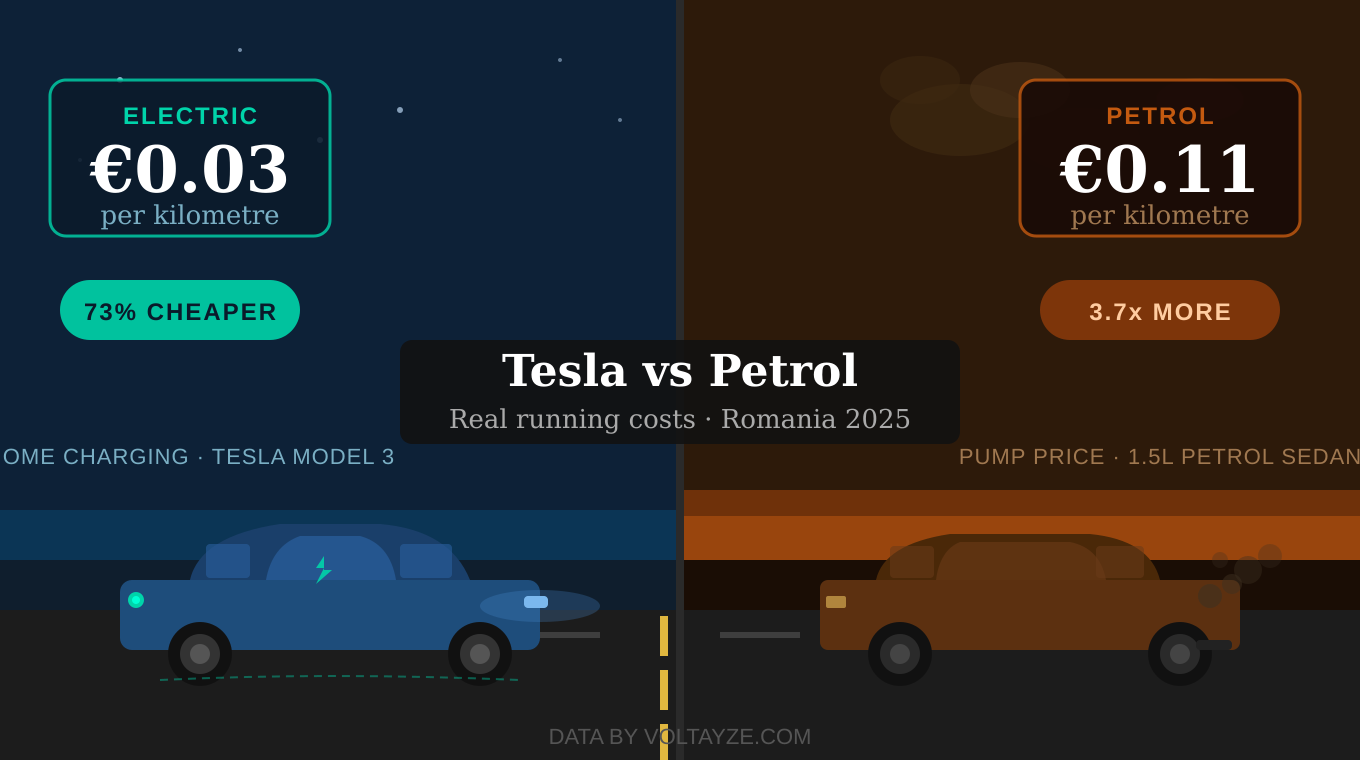
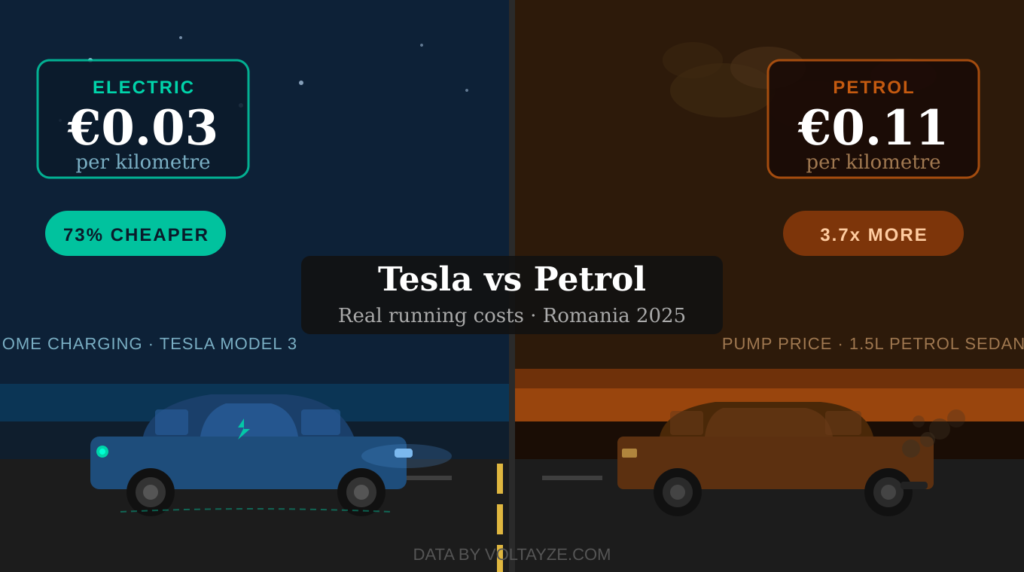
Key takeaway: charging a Tesla at home costs €0.030 per km. A petrol car costs €0.113 per km. That’s 73% cheaper per kilometre.
Annual Savings: What This Means in Real Money
Let’s translate the per-km numbers into annual savings based on typical driving distances:
| Annual km | Petrol cost/year | Tesla (home) cost/year | Annual saving | 5-year saving |
| 10,000 km | €1,134 | €304 | €830 | €4,150 |
| 15,000 km | €1,701 | €456 | €1,245 | €6,225 |
| 20,000 km | €2,268 | €608 | €1,660 | €8,300 |
| 30,000 km | €3,402 | €912 | €2,490 | €12,450 |
The average Romanian driver covers around 13,000–18,000 km per year. At 15,000 km annually, you’d save over €6,000 on fuel alone over five years — before even factoring in lower maintenance costs.
What About Maintenance Costs?
Fuel is only part of the running cost story. Electric cars have significantly fewer moving parts than petrol engines, which translates directly into lower servicing costs:
- No oil changes (Tesla Model 3 has no engine oil)
- No timing belt, spark plugs, or exhaust system
- Brake pads last much longer thanks to regenerative braking
- Main service items: tyre rotation, cabin air filter, brake fluid every 2 years
Industry data suggests EV maintenance costs are 30–40% lower than equivalent petrol vehicles over a 5-year period. For a Model 3, annual servicing typically runs €150–300, versus €400–600 for a comparable petrol saloon.
The Real-World Caveat: Winter in Romania
Romania’s winters are real, and cold weather affects EV range more than petrol cars. At -10°C, expect your Tesla’s real-world range to drop by 20–30%, and energy consumption to rise to around 20–22 kWh/100 km as the car uses energy to heat the cabin.
Even accounting for this, winter charging costs remain well below petrol. At 21 kWh/100 km and €0.19/kWh, your winter cost is €3.99/100 km — still less than a third of the petrol equivalent.
Pro tip: pre-conditioning your Tesla while it’s still plugged in (heating the cabin before you leave) costs you nothing extra and dramatically reduces winter range loss. Voltayze tracks this usage so you can see exactly how much energy goes to heating vs driving.
How Voltayze Helps You Track This
The numbers above are averages — your actual savings depend on your real driving patterns, your charging habits, and your specific routes. This is exactly the problem Voltayze was built to solve.
With Voltayze, you can:
- See your exact cost per km based on your real consumption data
- Track how much you’re saving vs a petrol equivalent, month by month
- Set your home electricity tariff and Supercharger costs for accurate calculations
- Get a monthly report showing your fuel savings in euros
- Monitor battery health to protect your car’s long-term value
Our users typically see their real-world savings fall between €900 and €1,800 per year depending on annual mileage — very close to the estimates in the table above.
Frequently Asked Questions
Is it cheaper to charge a Tesla at a public Supercharger than to fill up with petrol?
Mostly yes, but the margin is smaller. At Romanian Supercharger rates (~€0.35/kWh), you’re paying around €5.60/100 km — still about 50% cheaper than petrol at today’s prices. Home charging is where the biggest savings occur.
Does the price of electricity in Romania make EVs less competitive than in Western Europe?
Actually, no. Romania has relatively low household electricity prices compared to EU neighbours like Germany or Italy, which makes home charging particularly cost-effective. At €0.19/kWh, Romanian Tesla owners are among the cheapest to run in Europe.
What if petrol prices drop significantly?
Even if petrol fell back to €1.20/litre, home charging would still cost roughly 55% less per km. The break-even point — where petrol and EV costs equalise — would require electricity prices to nearly triple or petrol to fall below €0.70/litre. Neither is a realistic near-term scenario.
How do I calculate my own exact cost per km?
Divide your electricity tariff (in €/kWh) by 100, then multiply by your car’s real consumption (kWh/100 km). For a Tesla Model 3 at home: 0.19 × 16 / 100 = €0.030 per km. Voltayze does this calculation automatically using your real driving data.
The Bottom Line
When you compare Tesla cost per km vs petrol at current Romanian prices the conclusion is clear: driving electric in Romania is significantly cheaper per kilometre than petrol, even when you factor in Romania’s winters and occasional use of fast chargers. At typical Romanian driving distances, the annual fuel savings alone range from €800 to €2,500 — money that stays in your pocket rather than at the pump.
The variables that matter most are how much you drive, where you charge, and what your home electricity tariff is. Tracking these numbers precisely is the difference between knowing you’re saving money and knowing exactly how much.
Want to see your own numbers? Voltayze gives you a 30-day free trial — no credit card required. Connect your Tesla, and within 24 hours you’ll have a personalised dashboard showing your real cost per km and exactly how much you’re saving versus petrol.
How Much Do You Save With a Tesla? Calculate It Free